
Don't be Surprised
Why are we unable to anticipate the obvious?
It seems that human beings, despite all the incredible skills they bring along, lack one capability: Anticipating the future. No matter how significant and obvious the upcoming change is, we seem to have a tendency to either ignore it, or find short-term solutions to avoid it. And then, we are surprised.
One such example is . . .
Sustainable Farming
Metrics to feed 10bn people
A great article in the guardian on the potential of sustainable farming explains nicely why it is a matter of metrics to incentivize decisions that make sense in the long run.
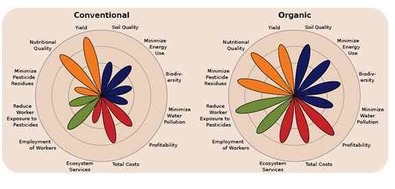
Thanks to the source for the picture
The US National Academy of Sciences defined four metrics of sustainability. According to . . .
Public Space
Appreciating what is a given to so many of us
Some things you only start appreciating when they're gone. As I spent some time in Nairobi this summer, public space has become one of these things for me.
In this city, most things in the everyday life are surrounded by fences. You enter through the gate, which is operated by a gatekeeper. And when you leave, you usually do . . .
Looking back at myself
A note to my present and future self
I recently met a person that reminded me a lot of myself a few years ago. It's like looking into a mirror that takes you back in time. And it made me think about the things I learned since then, especially in how I behave and interact with others. Three notes to myself, reminding me not to fall back into old habits.
If you . . .
Unconditional Apologies
Olympic lessons in PR
Every two years there is a free lesson in public relations. As the summer and winter Olympic Games get underway, the eyes of the world turn on the athletes. Cameras capture every moment of the two week spectacle, broadcasting successes and failures to billions of viewers.
In the midst of this craziness are the athletes. Many . . .
Changing an Operating System
What we can and cannot change in a world of humans
I recently came across an analogy Dan Pink made to explain human behaviour. He compared the world (and humans) with a computer operating system, that works with underlying instructions, protocols, and suppositions to create a certain behaviour.
The nice thing about this idea is that looking at the world as an operating system . . .
Control the Process
Because Goals are Beyond our Control
There's some things that are beyond our control. Macroeconomic changes impact businesses, accidents happen, other people make decisions that impact ourselves. All those things may lead to negative outcomes. We may not achieve a certain goal, or get behind schedule on a project.
The question that will be asked then is: "Why did . . .
